Compare top link-building marketplaces using a 10-point scorecard, pricing data, and a 90-day plan—and see where Link Publishers stands out and falls short
🔗 I compared top link-building marketplaces: What makes Link Publishers stand out?
Link building marketplaces have gone from a niche tool for agencies to a mainstream way for U.S. brands to buy placements. Search for the best ones and you will find dozens of lists, many of them written by the vendors themselves. This guide takes a different approach, explaining how marketplaces work, giving you a scorecard for comparing them, and comparing the main players on public information.
We also show where Link Publishers (linkpublishers.com) stands out and where it does not. Whether you are evaluating options for SaaS, tech, finance, health, local, or retail, structured comparison helps you avoid hype.
🛒 What is a link building marketplace?
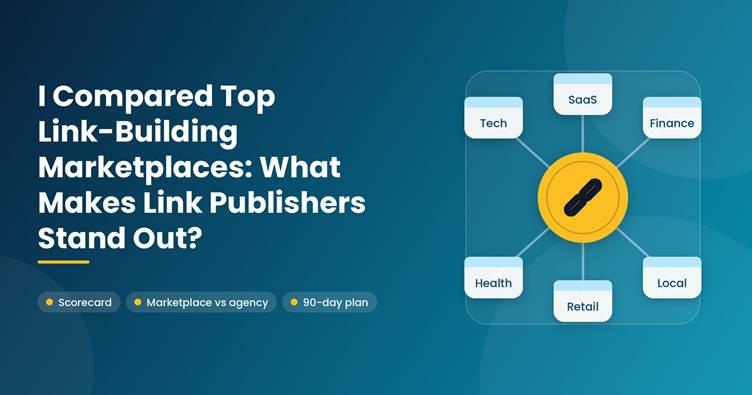
A link building marketplace is an online platform where publishers list sites that accept guest posts, link insertions, or sponsored content, and buyers choose placements from a catalog. Most show metrics such as domain rating (DR), domain authority (DA), traffic, category, and price so you can compare options before you order.
That transparency is the biggest difference between a marketplace and a traditional agency. As link building veteran Charles Floate put it in a 2026 podcast interview, transparency is probably the biggest difference between the two models.
⚖️ Marketplace vs. Agency: Which should you use?
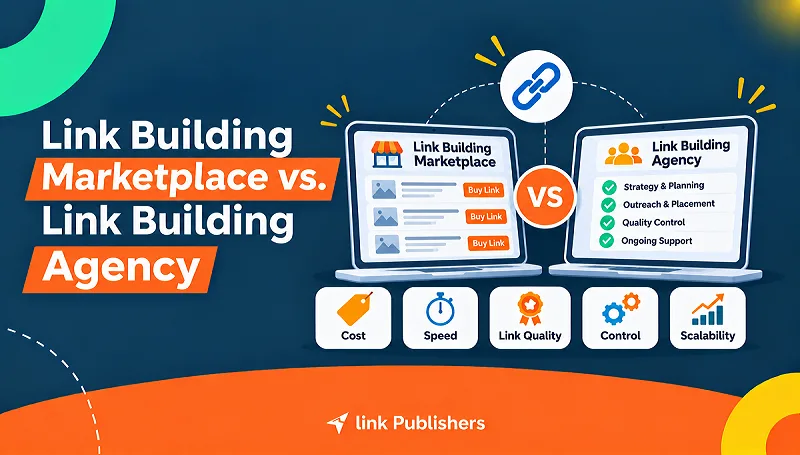
Choosing between a self-serve marketplace and a traditional agency depends on how much control, strategy, and delegation your team needs.
| Factor | Marketplace | Agency |
|---|---|---|
| Control | You choose every site | The agency chooses |
| Price visibility | Shown per site or per package | Often quoted per campaign or monthly retainer |
| Speed | Fast for pre-approved sites | Slower, strategy-led |
| Strategy | You supply it | The agency supplies it |
| Typical cost | Roughly $75 to $650 per post for most sites | Retainers can run from about $2,000 to $10,000+ per month |
| Best for | Teams with SEO skills and a clear plan | Teams who want strategy and delegation |
Cost ranges come from 2026 pricing studies and agency roundups. Digital PR campaigns sit higher, with one link building cost study citing roughly $1,250 to $1,500 per unique link and campaigns running $5,000 to $10,000 while delivering a handful of unique linking domains.
Many teams use both: a marketplace for tactical placements and an agency for strategy or digital PR.
📋 The scorecard: how to compare marketplaces
Before comparing names, decide what you are scoring. Here is a ten-point scorecard:
- 1 Catalog size and relevance: Not just how many sites, but how many in your niche with U.S. traffic.
- 2 Metric transparency: DR, DA, traffic, country split, and category visible before purchase.
- 3 Vetting quality: How does the platform screen publishers? Ask for the criteria.
- 4 Placement types: Guest posts, niche edits, brand mentions, digital PR.
- 5 Pricing clarity: Per-link prices, hidden fees, deposits, and minimums.
- 6 Turnaround: Typical time from order to live URL.
- 7 Guarantees: What happens if a post is removed or rejected?
- 8 AI and research tools: Do they improve relevance or just look good?
- 9 Agency features: White-label reports, multi-client organization.
- 10 Evidence: Independent reviews, press mentions, case studies.
Score each from one to five for your own priorities. A solo founder will weight price and relevance, while an agency will weight white-label, volume, and turnaround.
🏆 The main players, in brief
Based on public information in late 2026, here is how several notable platforms compare:
| Platform | Type | Notable signals |
|---|---|---|
| Link Publishers | AI-driven marketplace | 114,000+ vetted sites claimed; guest posts, niche edits, brand mentions, digital PR, managed campaigns; Relevink AI; white label |
| Press Whizz | AI-powered marketplace | 37,000 to 72,000+ sites across 90+ countries (varies by source); direct-from-publisher model; pay-per-link; free sign-up |
| FATJOE | Productized service | Fixed DR-based pricing (about $81 at DR10+ to about $513 at DR60+ in one review); brand mentions around $336; white-label reporting |
| Loganix | Managed service plus database | Guest posts from about $200; authority links from about $400; approval before placement; 10,000+ site database; Brand Mentions and AI Brand Links |
| Rhino Rank | Curated service | Guest posts from about $75; curated links from about $60 |
| WhitePress | Marketplace | Pay-per-publication; multi-language reach; Link Planner AI tool |
| Adsy | Large marketplace | Self-set site prices; 20+ filters; very large catalog by its own count |
Figures change often and come from the vendors or third-party reviews. Use them to frame your shortlist, then confirm directly.
⭐ What makes Link Publishers stand out
Here are the features that, in public information, differentiate Link Publishers from the field:
- 1 Catalog scale: The company's 2026 announcement cites 114,000+ vetted publisher sites, up from earlier directory listings citing 75,000 to 76,000+, placing it among the larger inventories in the category and giving buyers a better chance of finding niche-fit sites.
- 2 Relevance-led AI matching: Relevink AI recommends sites by niche and topical relevance, whereas many buyers still sort by DR, which is a blunt tool. A relevance-first starting point aligns with how search engines and AI systems assess authority on a topic.
- 3 A menu that matches how search is changing: Guest posts and niche edits serve classic SEO, brand mentions serve AI visibility, and digital PR serves authority and coverage, all under one account. An Ahrefs study of 75,000 brands found that branded web mentions correlated with Google AI Overview visibility at 0.664 versus 0.218 for backlinks, which is why more teams now buy links and mentions together.
- 4 A managed option beside self-serve: Link Publishers lists fully managed campaigns alongside self-serve browsing, which suits teams that start self-serve and later want to delegate.
- 5 Agency-friendly design: White-label support and a wide category range suit agencies serving many clients.
- 6 Positive usability signals in public reviews: Reviewers highlight clear site metrics, easy filtering by niche, traffic or DA, and reasonable costs.
⚠️ Where Link Publishers does not stand out (yet)
Honest comparisons cover limitations as well as strengths:
- Pricing visibility: Competitors such as FATJOE and Loganix publish starting prices, whereas Link Publishers shows prices per site inside the platform, so you cannot budget without browsing.
- Review volume: Directories show only a handful of reviews on some platforms, which is common for a growing company but means less independent evidence than long-established vendors.
- Published guarantee details: Confirm the removal and replacement policy before you order.
- Quality still varies by site: Like all marketplaces, verification is on you.
🎯 How to choose: three profiles
Different teams weigh trade-offs differently when building a shortlist:
- The founder or small business: Prioritize price, relevance, and simplicity by shortlisting Link Publishers, Rhino Rank, and Loganix and running a three-placement test.
- The in-house SEO: Prioritize relevance, control, and measurement by shortlisting Link Publishers and Press Whizz for browsing, with Loganix as managed backup and a strict vetting checklist.
- The agency: Prioritize volume, white-label reporting, and consistent turnaround by shortlisting Link Publishers, FATJOE, Loganix, and Press Whizz and testing each on a client with a small budget.
🚫 Common mistakes when using a marketplace
Avoiding predictable pitfalls protects both your budget and your domain's long-term health:
- 1 Buying by DR alone: A DR 70 site with no relevant traffic is worth less than a DR 40 niche site.
- 2 Skipping the traffic check: Verify traffic and country split independently.
- 3 Ignoring indexation: If a site's recent posts are not indexed, skip it.
- 4 Over-optimizing anchors: Use a natural mix.
- 5 Buying too fast: Spread orders over weeks.
- 6 Forgetting disclosure: Google's guidance asks for rel="sponsored" on paid links.
- 7 Treating mentions as an afterthought: In 2026, mentions are a core part of the plan.
🗓️ A simple 90-day plan
A structured testing window helps you evaluate real performance rather than relying on sales claims:
- Days 1 to 14: set up: Define target pages, prompts, and anchors, and build a shortlist of 15 to 20 sites per marketplace.
- Days 15 to 45: test: Order two to three placements per marketplace and record price, turnaround, and metrics.
- Days 46 to 75: measure: Check indexation, Search Console impressions, branded search, and AI answers for your prompt list.
- Days 76 to 90: decide: Keep the marketplaces that delivered relevance and reliability, scale those, and drop the rest.
🏁 Final verdict
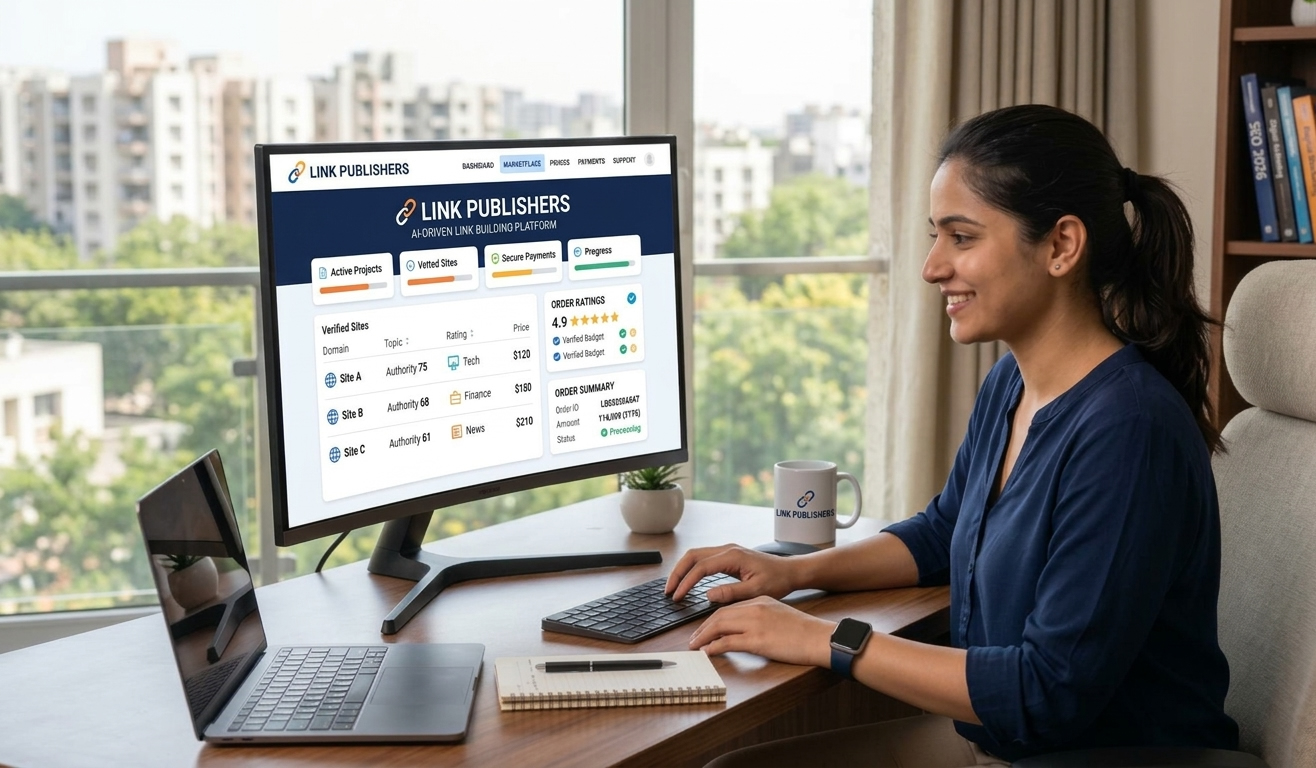
There is no single best link building marketplace, and any list that says otherwise is selling something. The right choice depends on your niche, budget, and how much control you want.
Link Publishers stands out for catalog scale, relevance-led AI matching and a service menu that covers guest posts, niche edits, brand mentions and digital PR in one account.
Its weaker spots are the lack of a public price list and a still-growing independent review base. Treat it as a strong candidate for your shortlist, test it against two other options, and decide using your own results.
FAQs
Frequently Asked QuestionsLocalización Web en Argentina: Voseo, Pagos y UX Local
Descubrí qué cambia al diseñar para usuarios argentinos. Aprende a aplicar voseo, formatos numéricos locales, Mercado Pago y optimización móvil
Otras noticias: